Need space?
 .png?width=1151&height=470&name=CJ_Logistics_Horizontal%20(ENG).png "CJ Logistics America")
 Contact us
 Sign-in
Subject: Market Dynamics, Technological Disruption, and Strategic Adaptation in Temperature-Controlled Supply Chains
Executive Summary
As we cross the midpoint of 2026, the global cold chain logistics market has reached a critical valuation of approximately $439.5 billion, moving along a robust compound annual growth rate (CAGR) of 14% [Research Nester, 2025].
Driven by the permanent "Amazon-effect" on grocery retail and an unprecedented reliance on complex biologics, the industry has fundamentally moved beyond mere refrigeration. In the summer of 2026, logistics success is no longer defined by keeping products cold; it is defined by predictive visibility—where artificial intelligence forecasts thermal excursions before they happen—and a rapid transition to green infrastructure capable of meeting aggressive global carbon mandates.
Market Drivers: The Summer 2026 Demand Landscape
1. The "Pharma-Freeze" and Biologic Dominance
The pharmaceutical sector's reliance on cold chain networks has officially eclipsed legacy ambient models. Passing mid-2026, nearly one-third of all approved drugs are biologics, with an estimated 85% requiring strict temperature management [Grand View Research, 2026]. We are navigating a massive, sustained surge in ultra-low temperature (ULT) demand (below -20°C), dictated by next-generation mRNA platforms, personalized cell therapies, and specialized clinical trials [Persistence Market Research, 2025].
2. E-Grocery Maturity & Quick-Commerce Realities
The online grocery ecosystem has achieved total structural maturity, tracking toward a staggering $794.86 billion global footprint [The Business Research Company, 2026]. The standard 3-to-5 day delivery window is obsolete. In mid-2026, the industry operates on a high-velocity "quick-commerce" infrastructure where consumers expect 30-minute to 2-hour delivery timelines for frozen and perishable goods. This shifts operational strain to two specific nodes:
- Micro-Fulfillment Centers (MFCs): Highly automated, ultra-dense urban cold-storage hubs situated inside metropolitan centers to shorten the final mile.
- Multi-Temperature Last-Mile Assets: Delivery vehicles integrated with modular, dynamic temperature zones capable of carrying ambient, chilled, and deep-frozen goods simultaneously.
3. Regulatory Compulsion: FSMA 204 Pressure
The FDA’s landmark FSMA 204 mandate, which launched its active rollout in early 2026, has completely reshaped corporate accountability. While full enforcement scales toward July 2028, summer 2026 has seen top-tier industry leaders deploy end-to-end trace documentation across the designated "Food Traceability List" [U.S. FDA, 2026]. This compliance wave has successfully transformed "digital twin" technology from an expensive enterprise experiment into a strict operational necessity.
Technological Integration: From Reactive to Predictive
The standard operating model for temperature-sensitive fulfillment has migrated from a reactive stance (discovering a ruined shipment at the receiving dock) to automated, real-time prediction.
The 2026 Cold Chain Tech Stack
|
Layer |
Technology |
Current 2026 Impact |
|
Edge Monitoring |
IoT & 5G Smart Sensors |
Continuous, real-time temperature and humidity pings sent every 60 seconds directly to cloud platforms. |
|
Intelligence |
AI Predictive Analytics |
Machine learning algorithms that evaluate external weather patterns and transit friction to forecast equipment failure 72 hours in advance. |
|
Execution |
Automated Storage & Retrieval (AS/RS) |
Dark, sub-zero warehouse automation where robotics handle palletization at -25°C, neutralizing severe labor deficits. |
The AI Advantage: Core Temperature Prediction
The modern industry baseline is Core Temperature Prediction. Rather than relying on physical product probes that damage packaging, AI algorithms interpret ambient transit history, container data, and external stressors. This allows operators to predict the internal core temperature of a pallet with 99% accuracy, proactively rescuing critical pharmaceutical assets and heavily reducing global vaccine spoilage.
The Sustainability Mandate: "The Move to -15°C"
Sustainability is no longer treated as a corporate marketing initiative; mid-2026 economics have transformed it into a core operational cost-cutter.
- Temperature Set-Point Shifts: The international movement to adjust the historic frozen standard from -18°C to -15°C has gained widespread multi-national support. This minor, science-backed adjustive shift delivers an immediate 5% to 10% reduction in net energy consumption without compromising food safety boundaries.
- Thermal Battery Warehousing: 2026 installations favor natural, low-GWP refrigerants (CO2, Ammonia) alongside solar-integrated roofing matrices. Modern cold storage buildings are increasingly utilized as "thermal batteries," over-cooling facilities during off-peak energy hours to reduce strains on local power grids during peak summer afternoons.
Strategic Challenges & Summer Risks
Despite aggressive market expansion, the peak summer season highlights three clear operational choke points:
- Infrastructure & Grid Fragility: Emerging corridors across APAC and LAMEA continue to battle fragile energy infrastructure. Increased seasonal heat waves expose these networks, forcing up to 40% higher spoilage rates compared to mature North American corridors.
- Cybersecurity & "Thermal Hacking": As logistics hubs become fully software-defined, the threat of cyber intrusions has escalated. Bad actors targeting cold storage networks via remote access to alter temperature set-points has emerged as a top-tier supply chain threat vector.
- Sub-Zero Labor Resilience: Human retention within sustained sub-zero spaces remains a persistent friction point. Forward-thinking operations are restructuring shifts toward automated short-interval schedules, pairing frontline teams with climate-resilient collaborative robots (cobots).
Strategic Blueprint for Enterprise Leaders
To insulate your operating margins against volatility throughout the remainder of 2026 and heading into 2027, enterprise supply chain executives must prioritize three core tactical moves:
- Enforce Absolute System Interoperability: Ensure your central Warehouse Management System (WMS) shares an immediate, bi-directional API layer with your third-party carriers’ IoT sensor platforms.
- De-risk with Asset Diversification: Break away from a total reliance on monolithic regional warehouses. Distribute inventory across a strategic combination of primary regional hubs and agile urban micro-fulfillment nodes.
- Optimize for Resilience Over Raw Unit Cost: The catastrophic loss of a single biopharmaceutical or high-value protein pallet can instantly wipe out the annual savings achieved by choosing a cut-rate, unmonitored carrier.
Case Study in Excellence: CJ Logistics America
Leading the 2026 Cold Chain Evolution
As market capacity and technological gaps stress traditional supply chains, CJ Logistics America (CJLA) has methodically expanded its North American asset footprint and technology infrastructure to provide an optimized, future-proof solution for food, beverage, and high-value protein sectors [CJ Logistics America, 2026].
1. Strategic Infrastructure Expansion
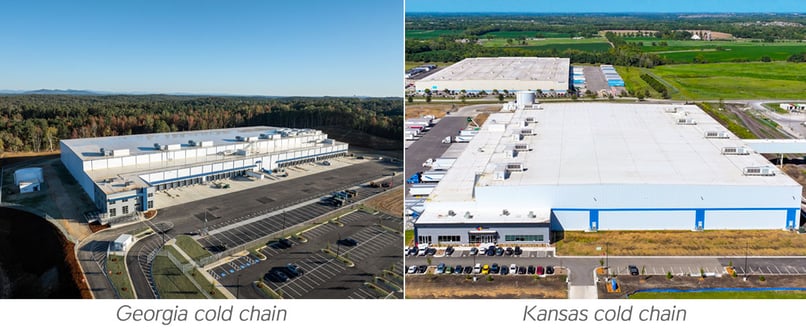
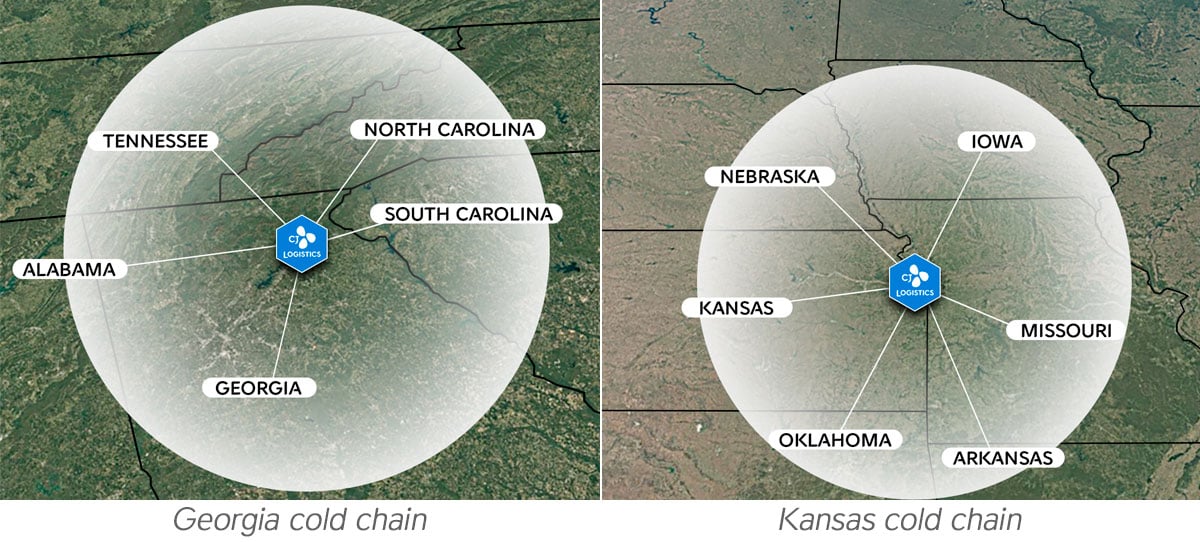
CJLA has effectively mitigated the national cold storage deficit by deploying major, state-of-the-art cold storage hubs positioned at critical transit cross-sections:
- Gainesville, Georgia (The Southeastern Protein Hub): A premier 270,000-square-foot facility built specifically for high-capacity distribution. The site features 30,000 racked pallet positions, on-site USDA inspection services, and immediate, seamless access to the Norfolk Southern railway and major Southeastern maritime ports.
- New Century, Kansas (The Central Midwest Hub): This 291,000-square-foot facility provides absolute central U.S. coverage, positioning enterprise partners within a one-day drive of 85% of the domestic population. The hub features an active direct rail spur and a total capacity of 44,000 pallets, making it a vital piece of infrastructure for coast-to-coast distribution networks.
2. Next-Gen Thermal Technology
CJLA facilities are systematically engineered around the modern standard of precise thermal control:
- QFM Blast Freezing: Advanced "QuickFreeze" mechanics that safely bring high-density protein and food shipments down to required core temperatures within 24 hours or less, beating standard industry cycles.
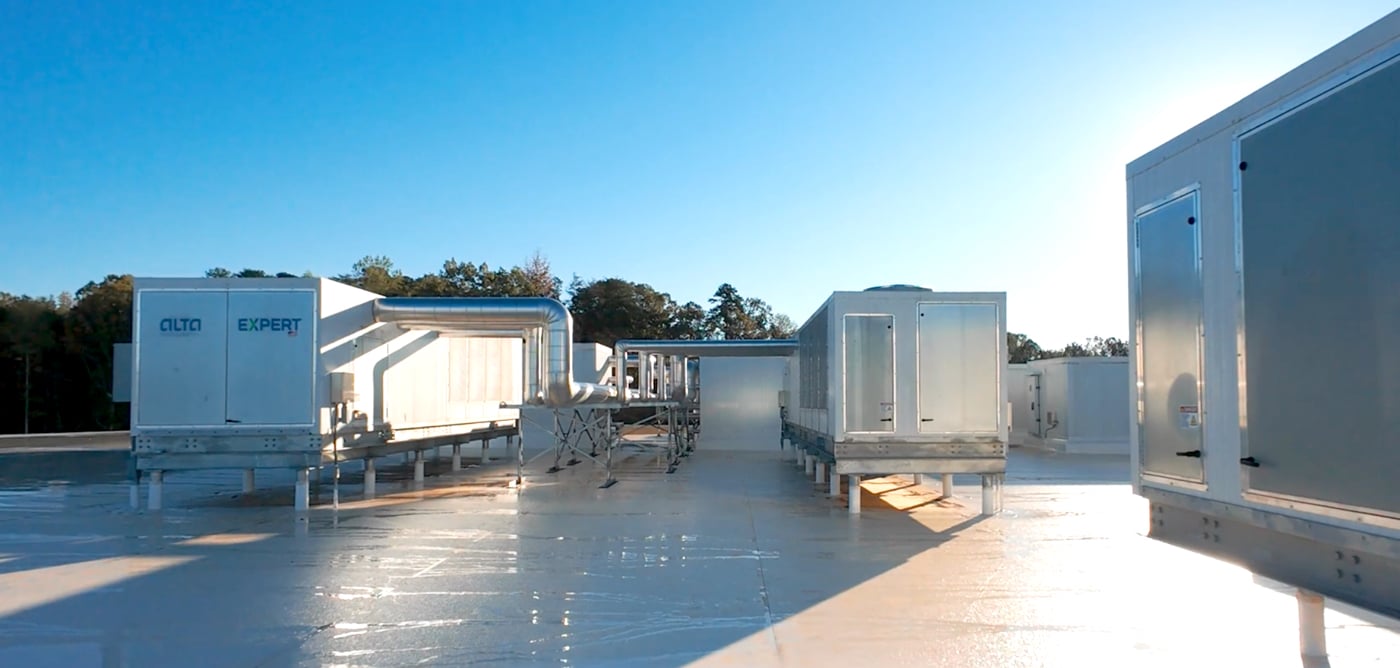
- Alta EXPERT Refrigeration: High-efficiency cooling units that lock in ultra-stable micro-climates across separate warehouse chambers while significantly reducing energy footprints—perfectly matching the global cost and sustainability goals sweeping the industry.
- Multi-Chamber Flexibility: Engineered with entirely distinct structural zones, the facilities seamlessly isolate proteins, frozen bakery items, and finished consumer goods to completely eliminate cross-contamination risks while optimizing localized energy consumption.
Value Proposition: Accelerating Growth with CJ Logistics
The modern supply chain environment requires a partner capable of moving beyond basic storage to act as a true Lead Logistics Partner (LLP). CJ Logistics America provides a holistic campus approach designed to convert supply chain variables into predictable advantages:
- Dynamic Scalability: A proven multi-customer warehousing model gives your brand the freedom to scale space and labor capacity up or down to match seasonal spikes, ensuring you only pay for utilized assets.
- Mitigated Transit Risk: By combining advanced cold storage assets with an award-winning transportation and freight forwarding network, CJLA eliminates the fragmented hand-offs where temperature breaks and visibility blind spots typically occur.
- Turnkey Compliance Protection: With FSMA 204 frameworks actively dictating brand choices, CJLA’s advanced WMS provides the real-time visibility, absolute product segmentation, and automated digital tracking data required to keep your brand secure, compliant, and market-ready.
References
- Global Market Insights (2026). Cold Chain Logistics Market Size, Growth Forecasts 2026–2035.
- Grand View Research (2026). Healthcare Cold Chain Third Party Logistics Market Report 2026–2033.
- Persistence Market Research (2025). Pharmaceutical Cold Chain Packaging Market: Global Industry Analysis.
- Research Nester (2025). Cold Chain Logistics Market Size & Share | Forecast Report.
- The Business Research Company (2026). Online Grocery Market Size, Share, Growth Report 2026.
- U.S. Food & Drug Administration (2026). FSMA Final Rule on Requirements for Additional Traceability Records for Certain Foods.
- CJ Logistics America (2026). Internal Capabilities Report: New Century, KS & Gainesville, GA Cold Storage Hubs.